Monday, August 19, 2019

Hogs and Water. A private citizen appeals to the Premier of Manitoba.


Dear Premier Brian Pallister,

It’s time for you and your government to stop playing Russian Roulette with the health of our waterways. Mr. Premier, you need to implement the “precautionary principle” and immediately stop the unbridled expansion of factory pig barns in the province. Scores of huge new barns have been going up - often in the face of opposition from nearby residents - for well over a year now, ever since your government slashed important environmental, health and safety regulations in order to make it happen. 
Lake Winnipeg, transformed into the bright, blue-green hue of poisonous algae.
Photo by European Space Agency.
There’s already plenty of both “circumstantial,” and scientific evidence that hog waste has played a role in reducing Lake Winnipeg to a mucky mess which can be seen from space (above).

Pigs have outnumbered people by the millions in our province for many years now. And that imbalance will only be widening with industry expansion. Hogs produce much more waste than humans. And, except for accidental releases, human sewage is treated while hog slurry - spread on vast areas of food crops as a fertilizer - is not.

And, instead of acting in the financial interests of foreign corporations, which now control Manitoba’s slaughtering facilities, your government should be thinking instead of your own citizens. 

For example, the ability of many cottage communities along the south basin to enjoy their properties this summer has been ruined by a dramatic buildup of poisonous algae which has collected along their beaches and seriously sickened some of their pets who drank the water. Some cottagers say, it’s the worst they’ve ever seen.

Could the reason your government has conducted no proper water testing be, it’ll show just how much the industry is contributing to the pollution? So, why not do the testing, gather the scientific data which has been lacking so far, and settle the issue, once and for all?

I believe many Manitobans share these concerns. If you do, please contact your local MLAs and tell them so.

Sincerely,
Larry Powell
Shoal Lake MB
Hog Watch Manitoba Warns Current Hog Industry Expansion Could Further Harm Lake Winnipeg

(Winnipeg –August 19, 2019) Hog Watch Manitoba(HWM) is warning the public that further increase in the number of pigs raised in Manitoba could bring even greater blue-green algae blooms to Lake Winnipeg and other Manitoba lakes. This summer the extent of the algae blooms in the south basin of Lake Winnipeg is devastating to many cottage communities, including Victoria Beach, Grand Beach and Lester Beach. The current Conservative government in Manitoba has introduced several measures to try to encourage the development of more industrial size hog barns. They ended the moratorium on hog barn development which had been instituted by the former provincial government. They brought in the Red Tape Reduction Bill, removing the prohibition on winter spreading of manure from legislation. Subsequently they brought in Bill 19 which aims to limit local control over new hog barn development.

HWM has requested that the government collect data to determine how much phosphorus is running off fields that have been fertilized with hog manure. Phosphorus is the key element that feeds the growth of blue-green algae and it is present in animal manure, human sewage and chemical fertilizers. Currently there is no actual data on how much phosphorus is coming from hog lagoons and spread fields and HWM believes that this data should be collected so evidence-based decisions can be made. “ We have the means to do this water sampling and data collection”, says Vicki Burns, Hog Watch Manitoba Steering Committee, “so why are we not being scientific about measuring and then controlling the amount of phosphorus we are allowing on our soils that is running off into our waters?”

According to Manitoba Pork there were 7.7 million pigs marketed in 2018 in Manitoba, compared to 780,000 back in 1975. Agriculture Minister Ralph Eichler has stated the government’s intention to see that number grow to 10 million each year. “This unlimited expansion of the industrial style hog industry has tremendous costs to our lake waters and the health of humans living in proximity to the hydrogen sulphide emissions from hog lagoons” says Janine Gibson, Hog Watch Member and Organic Agricultural Consultant and Inspector.
HWM is calling for data collection on run-off from hog farms before more industrial hog barns are allowed. The costs of polluting our lakes is too high a price to pay.
-30-
For more information contact:
Vicki Burns – 204-489-3852 – vickiburns@mts.net
Janine Gibson – 204-557-2529 - creativehealthconsulting@gmail.com

Friday, August 16, 2019

Fracking Boom in U.S. and Canada Largely to Blame for Global Methane Spike, Study Finds


EcoWatch
Image by Pixabay.
New research by a scientist at Cornell University warns that the fracking boom in the U.S. and Canada over the past decade is largely to blame for a large rise in methane in the earth's atmosphere — and that reducing emissions of the extremely potent greenhouse gas is crucial to help stem the international climate crisis. Story here.

Monday, August 12, 2019

'Disgusting and Disturbing': Trump Guts Endangered Species Act in Gift to Big Business


Common Dreams

"This administration seems set on damaging fragile ecosystems by prioritizing industry interests over science." Story here.
The embattled burrowing owl. A PinP photo.

Sunday, August 11, 2019

Black carbon lofts wildfire smoke high into the stratosphere to form a persistent plume


Science Magazine.
In 2017, western Canadian wildfires injected smoke into the stratosphere that was detectable by satellites for more than 8 months. The smoke plume rose from 12 to 23 kilometers within 2 months owing to solar heating of black carbon, extending the lifetime and latitudinal spread. Comparisons of model simulations to the rate of observed lofting indicate that 2% of the smoke mass was black carbon. The observed smoke lifetime in the stratosphere was 40% shorter than calculated with a standard model that does not consider photochemical loss of organic carbon. Photochemistry is represented by using an empirical ozone-organics reaction probability that matches the observed smoke decay. The observed rapid plume rise, latitudinal spread, and photochemical reactions provide new insights into potential global climate impacts from nuclear war. More here.
Smoke-filled skies over San Diego - fall 2007.
Photo by Eric Pettigrew.


Saturday, August 10, 2019

'Act before it's too late': The prairie province of Saskatchewan, Canada at high risk of water shortages, says global study


CBC News

Climate change, resource extraction, agriculture among causes of potential water shortage, says author. Story here.
Echo Lake, SK. Photo by Joe Mabel from Seattle.

Friday, August 9, 2019

Rachel was right


PAN
Yet another scientific study, released today, shows just how deadly our chemical-intensive farming system has become to pollinators and other insects. Story here,
Bumblebees forage on chives in an organic garden in Manitoba.
A PinP photo.
RELATED:

Thursday, August 8, 2019

To Slow Global Warming, U.N. Warns Agriculture Must Change


The Salt 
Humans must drastically alter food production to prevent the most catastrophic effects of global warming, according to a new report from the United Nations panel on climate change.
 Story here.
An intensive sheep operation.

Wednesday, August 7, 2019

Industrial fishing behind plummeting shark numbers


Science News
Research finds marine predators are significantly smaller and much rarer in areas closer to people. Story here.
An ocean "white-tip" shark. Photo by NOAA.

Tuesday, August 6, 2019

What can a large, but routine highway project teach us about our climate crisis?

Larry Powell explores that question in this picture story - "Thinking Globally. Acting Locally."

Earlier this summer, in a letter in my community newspaper, the Crossroads, I complained about a huge multi-million dollar roadbuilding project south of Shoal Lake, in southwestern Manitoba. 

Here’s why.
A convoy of dump trucks streams past my window.

Despite a standing warning from the United Nations that the construction sector needs to cut back on its huge carbon footprint “yesterday” if we are to meet our obligations under the Paris Climate Accord, a steady stream of diesel trucks rumbled through town for weeks, from dawn to dusk, right past my living and bedroom windows. (Above.)

And, scant weeks after the Parks and Wilderness Society informed us that biodiversity (the variety of plant and animal life on Earth) is declining faster than at any other time in human history, the trucks were making hundreds of round trips a day, hauling copious loads of gravel from a mine which, for years, has been transforming a beautiful and once-natural stretch of the Birdtail Valley west of here (below), into an ugly hub of commerce.  

Before...
Add caption
during...


During.
After.

I asked an employee of the gravel mine what the future holds. He speculated that, now stocks are depleting at the present site, expansion to the north might be in the works.
Before the project.

The Birdtail just upstream (north) of the mine.
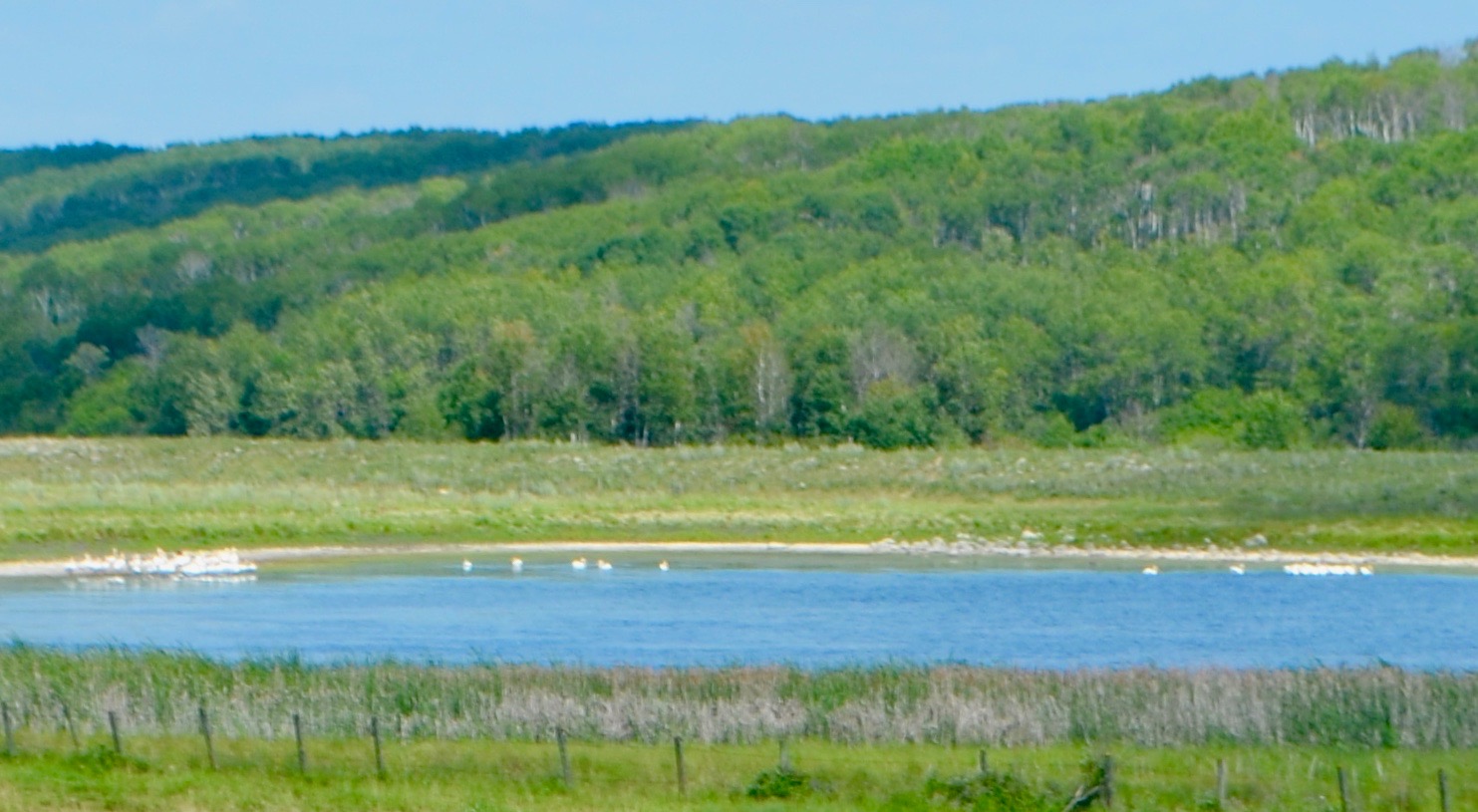
Pelicans gather on a nearby pond.
Rumour has it the mine will be expanding in this direction.
(All photos by PinP.)
Yet my letter was met with a deafening silence. I wonder if a recent study by the University of BC might help explain why. It has found that high school students in Manitoba are actually being taught that the science of climate change has not been settled yet!

If that is what they are being taught, it is disturbing, unacceptable and untrue!. The science is settled! There’s an overwhelming and longstanding consensus among the world’s top climatologists. We humans are altering the nature of our atmosphere by the amount of fossil fuels we're burning. This is trapping heat close to the earth’s surface. And, if we do nothing, the only home we have could morph into a place that’s not just inhospitable, but downright deadly! 

So, would Earth have been spared from the worst ravages of manmade climate change had this project not gone ahead? 

Of course not.

But are we doomed to a worst-case scenario if every jurisdiction in the world plowed ahead with "business-as-usual," as mine is doing? 

Absolutely!
-------------
P.S. I have written this in the spirit of the message we once tried to impart to the young. "Think globally. Act locally." Has that notion proven to be a mirage? A thing of the past? Please tell me it is not! l.p.
-->

                                 -30-

Friday, August 2, 2019

Cargill Closes Feed Mills in China Due to African Swine Fever


FarmJournal’s
PORK
Cargill Inc has closed animal feed-mills in China in recent months, partly because of the devastating spread of African swine fever (ASF) that has reduced demand. Story here.
One of millions of ASF victims.

"The incidence and range of many emerging diseases are influenced by the intensification of..livestock systems."  U.N. report - "Agriculture at a Crossroads" 2009

BLOGGER REMOVES CLIMATE POST UNTIL FURTHER VERFICATION

 Friends; I've now taken down a video I posted recently. In it, I quoted some information directly (cut & pasted with some very mino...