
PLANET in PERIL - WHERE SCIENCE GETS RESPECT. DENIED HER NATURAL INSTINCTS T0 ROOT & FORAGE, THIS YOUNG SOW GOES MAD, BITING THE STEEL BARS THAT CONFINE HER.
Saturday, November 1, 2014

At Least One California Town Is Now Bone-Dry As Megadrought Continues
AlterNet
A poor, rural community in California's agricultural belt has run out of water. Story here.
Friday, October 31, 2014
Research Suggests Our Past, Prolific Use Of The Insecticide DDT May Still Be Contributing To A Scourge Of Modern-Day Diseases Related To Obesity.
Is a world-wide ban now the only ethical thing to do?


by Larry Powell
Did your parents farm In Canada in the years following World War 11, as mine did? If so, little would they have dreamed of the health dangers lurking within the popular chemical, DDT, which they might well have been spraying on their fields.
The product
was applied widely (some say indiscriminately) back then to kill bugs that were consuming food crops and
forests and spreading human diseases like typhus and malaria. Just
as common were assurances from government and industry that “all was well.”
But DDT was banned in North America in the 70’s after Rachel Carson exposed
it in her book,“Silent Spring” as the
culprit in massive die-offs of birds and fish and as a “definite chemical carcinogen.”
DDT made a significant
resurgence in the early 2000’s, however.
That’s when the Bill and Melinda Gates Foundation and the World Health Organization began promoting programs to control malaria, notably in Sub-Saharan Africa. DDT is sprayed indoors and used to treat bed nets to protect people from malaria mosquitoes. It is now estimated up to 5 thousand tonnes are applied yearly.
That’s when the Bill and Melinda Gates Foundation and the World Health Organization began promoting programs to control malaria, notably in Sub-Saharan Africa. DDT is sprayed indoors and used to treat bed nets to protect people from malaria mosquitoes. It is now estimated up to 5 thousand tonnes are applied yearly.
But the degree to which DDT can harm not only those directly
exposed, but their offspring several generations later, has only recently become
better understood.
Late last year, a research team at Washington State
University (WSU), published a study with a disturbing finding; “The biohazards of DDT
are significantly greater than anticipated.”
In experiments with laboratory rats, the team
discovered that the chemical seems to have the ability to cause serious ailments
related to obesity (metabolic disease)
in offspring born to parents directly
exposed, even though those offspring had
no such exposure, themselves. They include diabetes,
diseases of the liver, kidney, heart and reproductive organs, male infertility
and a shorter life.
DDT
thus joins a growing list of substances such as jet fuel and dioxins with the
same dubious ability.
So the researchers now believe that, while diet and lifestyle are playing a role, the DDT applied during its heyday, too, is still contributing to the deadly epidemic of obesity that has been sweeping this continent for years.
“No known genetic mechanism could explain the
rapid increase in the incidence of obesity in the last 30 years,” observes the
WSU study.
Queens University in
Ontario
estimates that 57 thousand Canadians died of obesity-related ailments between
1985 and 2,000. And Memorial University in Newfoundland has
concluded that obesity rates “tripled between 1985 and 2011.”

A
biology teacher at WSU, Michael Skinner (above), headed that study. In an e-mail to PinP, Dr.
Skinner confidently defends his team’s research results.
“In
the 40s and 50s, all of North America and the entire population was exposed to
DDT. We are now three generations from the 1950s, when the obesity metabolic
disease frequency was around 5% and today is near 40% of the population. So,
yes, some of the disease today is due to these ancestral exposures.”
Some researchers now believe DDT should be banned, worldwide.
This summer, WSU did a follow-up study, this
time with unusual input from the
its School of Philosophy. It examined
the ethical and moral implications of
DDT’s continued use, in the wake of last year’s disturbing revelations. “Current day exposures need to now be considered
in light of the transgenerational actions of DDT,” the team concludes. As
Prof. Skinner puts it, a worldwide ban is now a matter of “environmental
justice. There are alternatives with shorter half-lives that need to be
considered.”
But convincing the world that a total ban is needed,
may not be easy.
In 2009, the Annual Review of Entomology reported that, after some two decades
of DDT application, the death rate
from malaria had plummeted. In 1900, it was claiming more than 19 lives per
ten thousand population; in 1970, fewer
than two. The Review calls that “a massive reduction.” And the Gates
Foundation claims its
program has helped reduce the death toll from malaria by more than 40 percent
over the past dozen years or so.
But the WSU ethics paper poses some convincing
arguments of its own; Health implications uncovered by the recent research are endangering individuals "who are not able to have any
voice in the decision to use the pesticide." So we must now balance the number of lives being saved from
malaria, against the implications that its continued usage will surely have. “There are now many accounts of socially
disadvantaged, ethnic groups and the poor, suffering the ill effects of
environmental degradation,” states the report. “DDT use in the developing world looks set to be yet another case in
that sad history. The harm will only fully emerge over the course of a number
of generations.”
The report concludes that the burden of proof must
now shift back to those advocating for its continued use. And the worst thing that could happen would be to
carry on with the status quo without careful consideration of the consequences.
-30-
Postscript: I asked the Gates Foundation and the World Health Organization for comments on this some time ago. I am still waiting for their responses.
---------
Postscript: I asked the Gates Foundation and the World Health Organization for comments on this some time ago. I am still waiting for their responses.
---------
(This article is also posted on "OpEd News," where it drew about a dozen comments! Please read them here.)
Related:
Canada's Farm Protections a Remaining Hurdle to Major Trade Deal: U.S.
Winnipeg Free Press
WASHINGTON - Access to Canada's tightly controlled agriculture market is among the main remaining hurdles to a historic 12-country free-trade deal, the U.S. administration said Thursday. Story here.
Wednesday, October 29, 2014
Livestock Die As The Caribbean Gets Hotter
PARAMARIBO, Suriname, Oct 8 2014 (IPS) - Livestock farmers in the Caribbean are finding it increasingly difficult and expensive to rear healthy animals because of climate change, a situation that poses a significant threat to a region that is already too dependent on imports to feed its population. Story here.

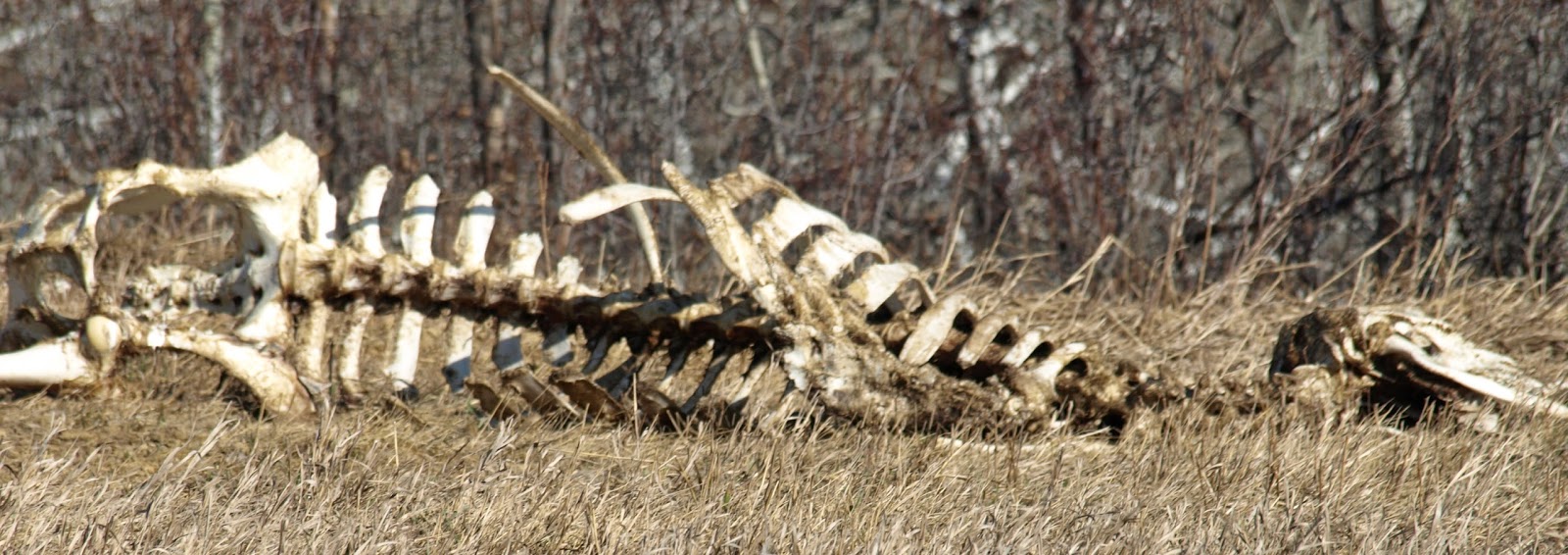
A cow skeleton in Canada. PinP photo.
Tuesday, October 28, 2014
Stop Cruel & Wasteful Fishing Practices - PLEASE SIGN!
 |
Hi Larry,
I just wanted to check whether you saw my email from the other day, containing shocking footage from industrial tuna boats?
Already an incredible 103,000 emails have gone to Princes and John West, demanding they clean up their tuna.
The campaign is taking off - will you add your name too?
https://secure.greenpeace.org.uk/dirty-tuna3
For the oceans,
Victoria
|
Spring Heat Wave In Australia Breaks Records Across The Country
CLIMATEPROGRESS
Australia’s summer doesn’t start until December, but the country is still baking in a record-breaking spring heat wave. Story here.
Bye Bye Bees? Not If We Can Help It!
|
Monday, October 27, 2014
Confirmed: California Aquifers Contaminated With Billions Of Gallons of Fracking Wastewater
DESMOGBLOG.COM
The California State Water Resources Board has confirmed that at least nine sites were dumping wastewater contaminated with fracking fluids and other pollutants into aquifers protected by state law and the federal Safe Drinking Water Act. Story here.
Fertilizer Warning: Don’t Pay $12-An-Acre For ‘Foo-Foo Dust’
Manitoba Co-Operator
Buyer beware, the Canadian Food Inspection Agency no longer tests fertilizers for efficacy and quality. Story here.
Friday, October 24, 2014
UN Agencies Launch New Joint Initiative Targeting Elimination of Global Food Waste
UN News Centre

Larry Powell P in P photo.
The world wastes enough food to feed an estimated two billion people, the United Nations said today. Story here.
Subscribe to:
Comments (Atom)


-
Are hungry kids a priority for the Harper government? by Larry Powell The forum (for the riding of Dauphin - Swan River - Neepawa) w...
-
by Larry Powell Planet In Peril has sorted through some of the confusion surrounding the absence of Robert Sopuck, the Conservative M...
-
 Larry Powell Powell is a veteran, award-winning journalist based in Shoal Lake, Manitoba, Canada. He specialize in stories about agriculture...